What density should I choose: 600, 1,000, or 10,000 stems per hectare
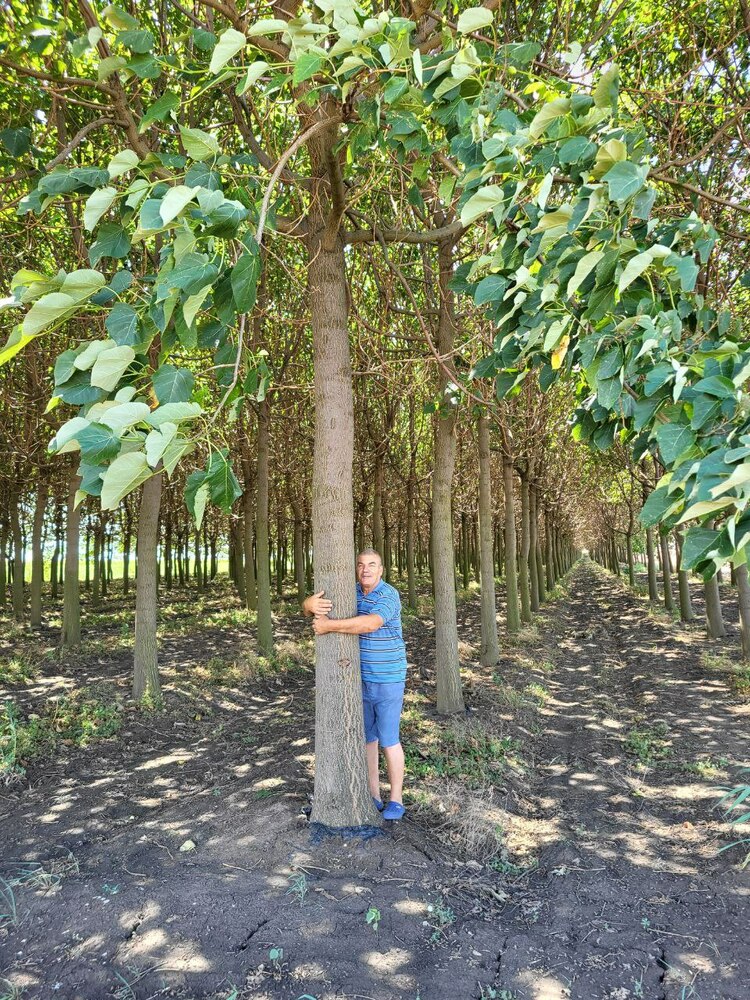
The density determines the final diameter, and thus the price per m³. The three scenarios calculated over ten years.
Lire →Producer in France and Bulgaria. Sliding scale prices from 1,000 plants, up to 200,000 units per season.
We don't just sell plants: soil analysis, planting plan, irrigation schedule, and timber buy-back at maturity. A single point of contact from soil to sawmill.
Prices are exclusive of tax for bare-root Paulownia Energy® XL plants. The tier discount is applied automatically in the cart; for orders over 50,000 plants, a personalized quote is required.
Get my personalized gridFour clones selected according to their purpose: timber, biomass, urban landscaping. Each sheet shows the growth curve measured on our plots.
Characteristics of the variety: Paulownia Shan Tong is one of the best Paulownia va...
Characteristics of the variety: Paulownia Shan Tong is one of the best varieties of...
The clone, density, and schedule change completely depending on the objective. Tell us what you're aiming for, and we'll filter for you.
400-600 stems/ha, formative pruning, 8-10 year rotation. The most valuable market.
Short-rotation coppice, 10,000 stems/ha, first cut at 3 years then every 3 years from the same stool.
Measured sequestration, methodological file, annual dendrometric monitoring for your credits.
Shade for livestock, foliar fodder, windbreak. Compatible with your existing CAP aids.
Early and abundant flowering, light honey comparable to acacia. Combines with timber management.
In vitro supply, technical training, negotiable territorial exclusivity.
Area and purpose: you get the number of plants, the budget, and the estimated timber revenue at maturity.
Indicative estimate excluding land, soil work, irrigation, and taxes. Volumes calculated from our plot surveys in Bulgaria and Charente-Maritime; actual results depend on soil, rainfall, and management.
You choose the surface, we take care of the rest. Plants, transport, and support all in one order.
The steps are numbered because they actually follow this order: each one conditions the next.
Area, soil, rainfall, access to water. 30-minute, no-obligation call.
Soil analysis, clone and density selection, dated planting schedule.
Firm prices by tier, 30% deposit, production slot reserved at the nursery.
Palletized delivery or mechanized planting by our teams, with site acceptance.
Annual visits, training pruning, then purchase of wood according to the contract signed at the outset.
The risk of a forestry project is not the growth itself: it's knowing who to sell to in eight years. The buy-back contract is signed on the day the seedlings are delivered, at a guaranteed floor price, and you remain free to sell elsewhere if the market rises.
Read the contract terms
Our own plantation: clone testing ground and growth benchmark since 2019.
Conversion of cereal land to agroforestry, inter-row cropping and cattle shade.
Short rotation coppice for collective boiler room, subsurface drip irrigation.
Delivery of 12,000 bare-root plants on two pallets, received within 48 hours and conforming to the advertised caliper. Regrowth exceeded 94% in the first year.
The planting plan was precise down to the spacing and pruning schedule. That's what convinced us: the others were selling plants, not a technical itinerary.
Buyback contract signed upon order, this is what unlocked our bank financing. Small downside of a two-week delay in delivery, announced beforehand.
The density determines the final diameter, and thus the price per m³. The three scenarios calculated over ten years.
Lire →
800 mm annually, yes — but how is that distributed. The thresholds beyond which growth stops.
Lire →
What is fundable, what isn't, and the documents to gather before planting.
Lire →1,000 plants at a professional sliding scale rate. Below this quantity, orders are still possible at the catalog rate, without price breaks. For local authorities and containerized plants, there is no minimum.
Bare root stock in plastic-wrapped pallets, from November to April depending on the climatic zone. Potted plants available all year round. Each pallet bears its phytosanitary passport and the clone's batch number.
Replacement of missing plants beyond the contractual rate, subject to compliance with the provided technical itinerary: soil preparation, spacing, irrigation in the first year. The assessment is made during the visit at the end of the first season.
No. It's a guaranteed floor price that you can activate or not. If the market is higher at harvest, you sell elsewhere without penalty.
Yes, to 32 countries to date. We handle the phytosanitary export certificate and customs documents; costs and lead times depend on the country and are quoted in the estimate.
Yes, on our plots in Charente-Maritime all year round, and in Bulgaria by group appointment. We also connect you with customers who have planted in your region.
Provide us with the area and the purpose. You will receive a tiered pricing grid, a realistic planting schedule, and the draft buyback contract — everything you need to present your case to your bank.
+33 7 87 71 09 11 · Vadym Kudryk, Founder — French, English, Ukrainian
Located in Aulnay, Charente-Maritime, and Plovdiv, Bulgaria, we produce and supply Paulownia seedlings for industrial planting projects: timber, short-rotation biomass, agroforestry, carbon projects, and community development. Our clones are derived from in vitro culture and have been selected on our own plots since 2019.
We support every project from soil analysis to timber buy-back: clone selection based on rainfall and hardiness of the area, planting density, irrigation plan, formative pruning, annual dendrometric monitoring. Farmers, forestry groups, land investors, local authorities, and reseller nurseries benefit from sliding scale prices starting at 1,000 plants and multi-year contracts for over 50,000 units.